The History of Bandanas in Black Labor and Hip-Hop Culture
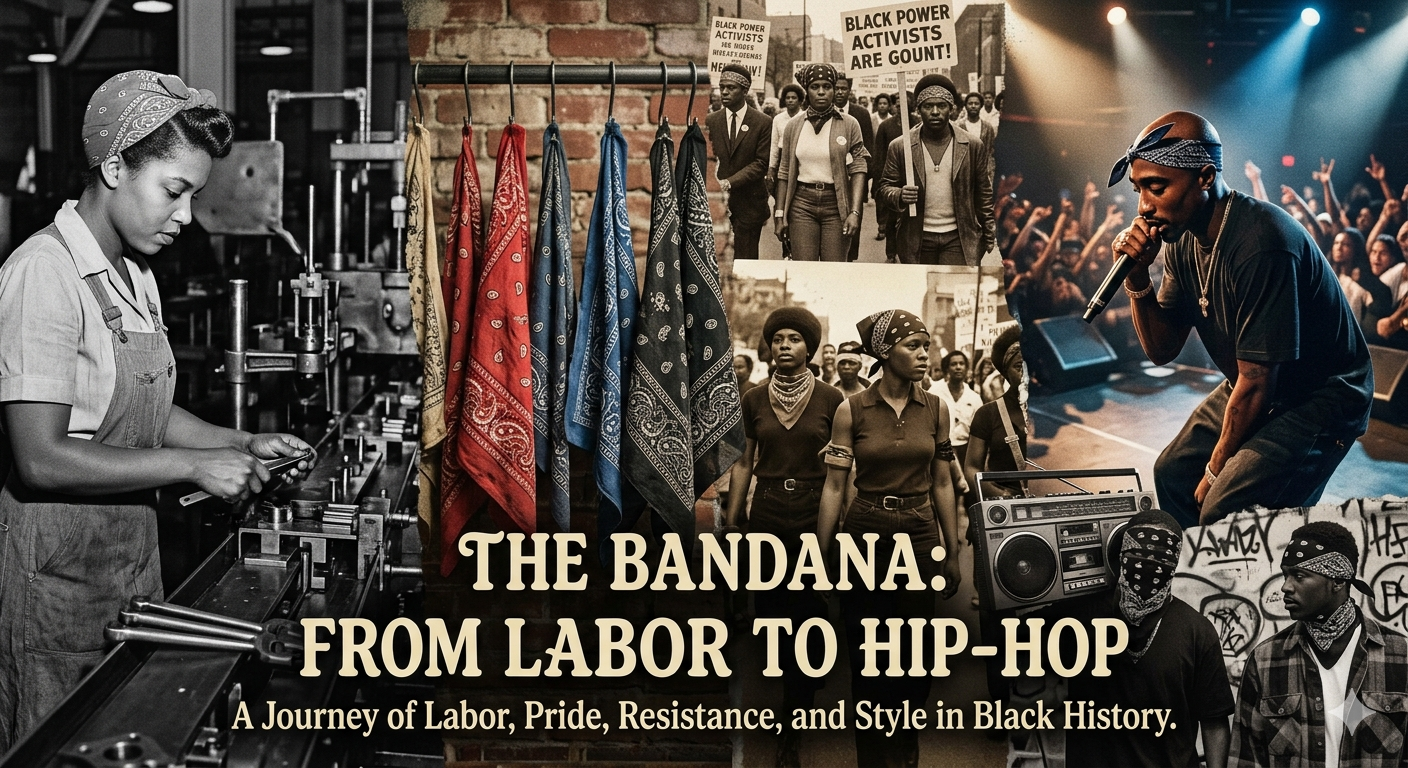
From factory floors to hip-hop stages, the bandana has travelled a powerful and layered journey in Black history. What began as a practical head covering evolved into a visual language of labor, survival, pride, resistance, and cultural belonging.
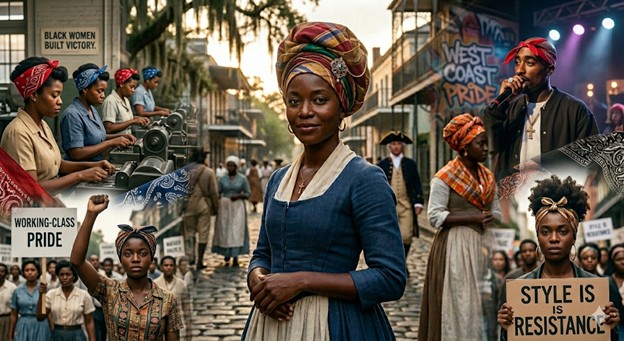
During World War II, thousands of Black women entered industrial jobs across the United States as part of the wartime labor force. Popular imagery often centers white women under the banner of Rosie the Riveter, but Black women were very much part of that workforce. In shipyards, factories, and plants, headscarves and bandanas were worn to protect hair from machinery and debris. Tied securely at the crown or wrapped close to the scalp, these scarves were practical tools of safety and efficiency.
Yet even then, the headscarf carried a deeper meaning. For Black women, covering the hair was not new. Across the African diaspora, headwrapping traditions long signified respectability, spirituality, and cultural identity. In the American South, headscarves had also been associated with domestic labour and racialized class hierarchies. On the factory floor, however, the same garment took on new symbolism: economic participation, wartime contribution, and a shift in gender roles. The image of a Black woman in a tied bandana became one of quiet defiance – proof of capability in spaces that had historically excluded her.
By the mid-20th century, the bandana began appearing in new social and political contexts. During the Civil Rights and Black Power movements, clothing became an intentional marker of solidarity and resistance. While leather jackets and berets became iconic in certain activist circles, headscarves and bandanas continued to circulate as everyday symbols of working-class pride and cultural continuity. How one tied a scarf – forward knot, side knot, fully wrapped – could signal affiliation, style preference, or generational identity.
The 1990s marked another major transformation. In West Coast hip-hop culture, the bandana became deeply embedded in street style and music aesthetics. Artists like Tupac Shakur popularized the front-tied bandana, worn low across the forehead with the knot centered. What had once been industrial workwear now communicated something entirely different: neighborhood loyalty, resistance to mainstream norms, respectability politics, and an unapologetic embrace of urban Black identity.
At the same time, R&B artists incorporated silk scarves and bandanas into performance fashion, blending softness and edge. The accessory moved fluidly between masculinity and femininity, streetwear and glamour. It was accessible – affordable, adaptable, and easy to personalize – making it a democratic fashion statement within communities often excluded from high fashion spaces.
Importantly, the bandana also carried complex and sometimes dangerous connotations. In certain cities, colours and tying styles could be read as indicators of gang affiliation, turning a simple accessory into a coded and sometimes risky statement. This layering of meaning demonstrates how Black fashion items often function beyond aesthetics; they operate within social systems shaped by race, policing, and territorial identity.
Today, the bandana continues to evolve. It appears in high-fashion collections, natural hair styling tutorials, protest movements, and everyday streetwear. Whether worn as a protective wrap, a nostalgic nod to 90s culture, or a political signal, the choice remains intentional.
Across decades, one truth endures: the bandana has never been “just” fabric. For Black communities, it has been a labour uniform, a survival tool, a cultural marker, and an artistic expression.
Each fold, colour, and knot tells a story – of work, of music, of resistance, and of the enduring power to define style on one’s own terms.