Why the Dashiki Became a Pan-African Emblem of Pride
The dashiki is more than a garment – it is a declaration.
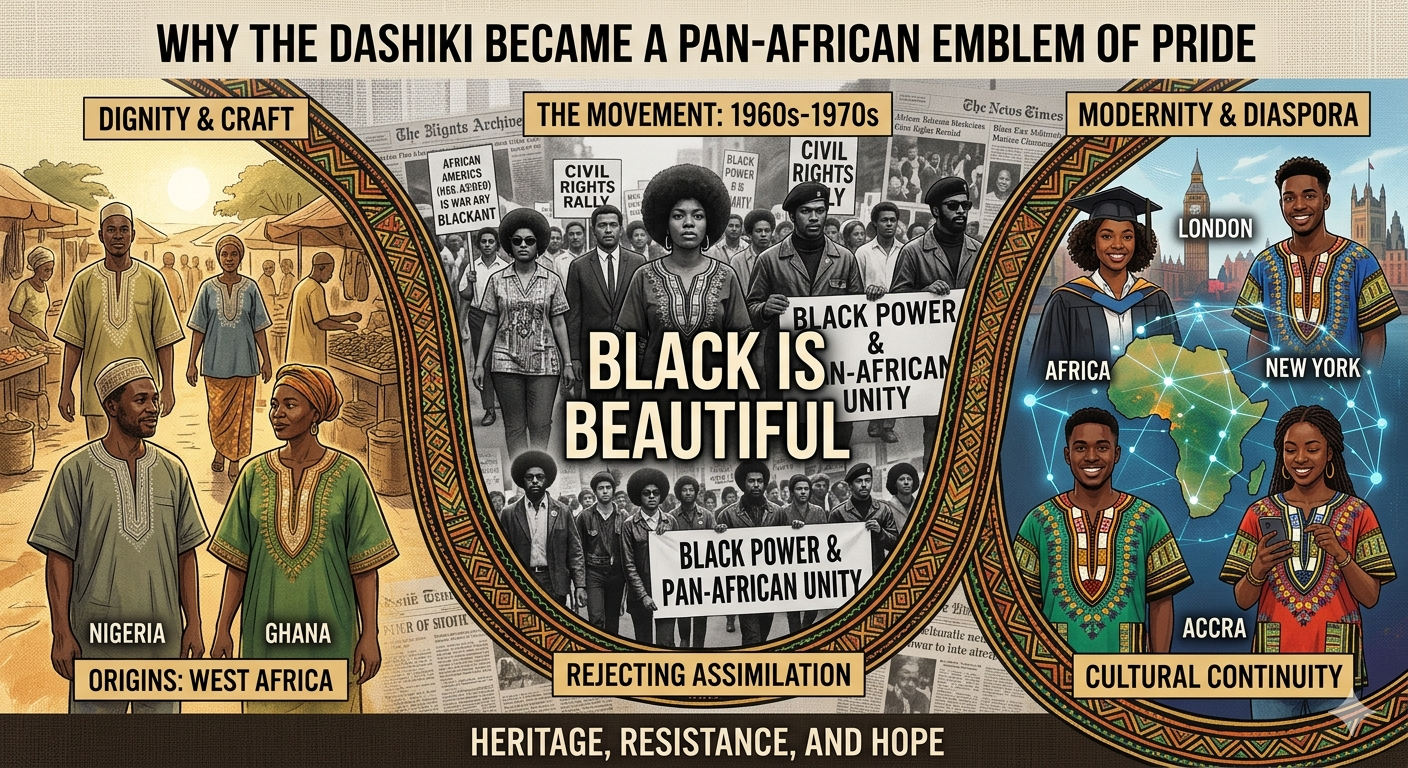
Originating in West Africa, the dashiki is a loose-fitting, brightly colored tunic traditionally worn across countries such as Nigeria, Ghana, and Senegal. Its name is derived from the Yoruba word danshiki, meaning “shirt.” Designed for comfort in warm climates, the dashiki features ornate embroidery around the neckline, bold prints, and flowing construction that allows ease of movement. Long before it became politicized in the United States, it was simply everyday attire – functional, beautiful, and deeply rooted in African textile traditions.
But history would give the dashiki new meaning.
In the 1960s and 1970s, during the height of the Civil Rights and Black Power movements in the United States, African Americans began seeking visible ways to reconnect with ancestral roots severed by slavery. At a time when European beauty standards dominated fashion, hair, and dress codes, wearing African garments became an intentional rejection of assimilation. The dashiki emerged as one of the most recognizable symbols of this cultural shift.
Figures within the broader Black liberation struggle – including members of organizations like the Black Panther Party – embraced clothing as political language. While leather jackets and berets became associated with militant organizing, the dashiki symbolized cultural nationalism and Pan-African unity. It represented a turning inward toward African heritage rather than outward toward Western approval.
To wear a dashiki in 1968 was not merely a fashion choice. It was a statement: Black is beautiful. Africa is worthy. Our history did not begin with enslavement.
This shift was radical in its simplicity. For centuries, Black Americans had been pressured to conform to Eurocentric dress standards to be deemed respectable or employable. Straightened hair, tailored suits, and muted tones were markers of social mobility. The dashiki disrupted that narrative. Its vibrant colours, loose silhouette, and unapologetically African aesthetic challenged the idea that professionalism or dignity required proximity to whiteness.
College campuses, community gatherings, and cultural festivals became sites of this sartorial revolution. Dashikis appeared at rallies, poetry readings, and family celebrations. They were worn by artists, activists, and everyday people who wanted their clothing to reflect pride rather than survival.
Over time, the dashiki also entered mainstream American fashion cycles – sometimes celebrated, sometimes appropriated. In the 1970s, it was adopted in soul and funk culture. In later decades, it reappeared in hip-hop visuals and Afrocentric revival movements. Each resurgence reaffirmed its layered meanings: resistance, heritage, and style.
Importantly, the dashiki’s significance extends beyond the United States. Across the African diaspora, it continues to function as a bridge – linking contemporary identity to ancestral lineage. It is worn at weddings, graduations, naming ceremonies, and cultural events. For second- and third-generation immigrants, it can be a tactile connection to stories told by parents and grandparents.
Today, in an era of global fashion and digital visibility, the dashiki stands at the intersection of tradition and modernity. Designers reinterpret its patterns. Young people style it with sneakers or tailored trousers. It adapts without losing its essence.
The evolution of the dashiki reveals a deeper truth about fashion: clothing can hold memory. It can resist erasure. It can communicate solidarity without a single spoken word.
What began as a practical West African tunic became a global emblem of Black pride and cultural continuity. The dashiki remains what it has always been – a garment rooted in dignity, transformed into a symbol of reclamation, and worn as both heritage and hope.